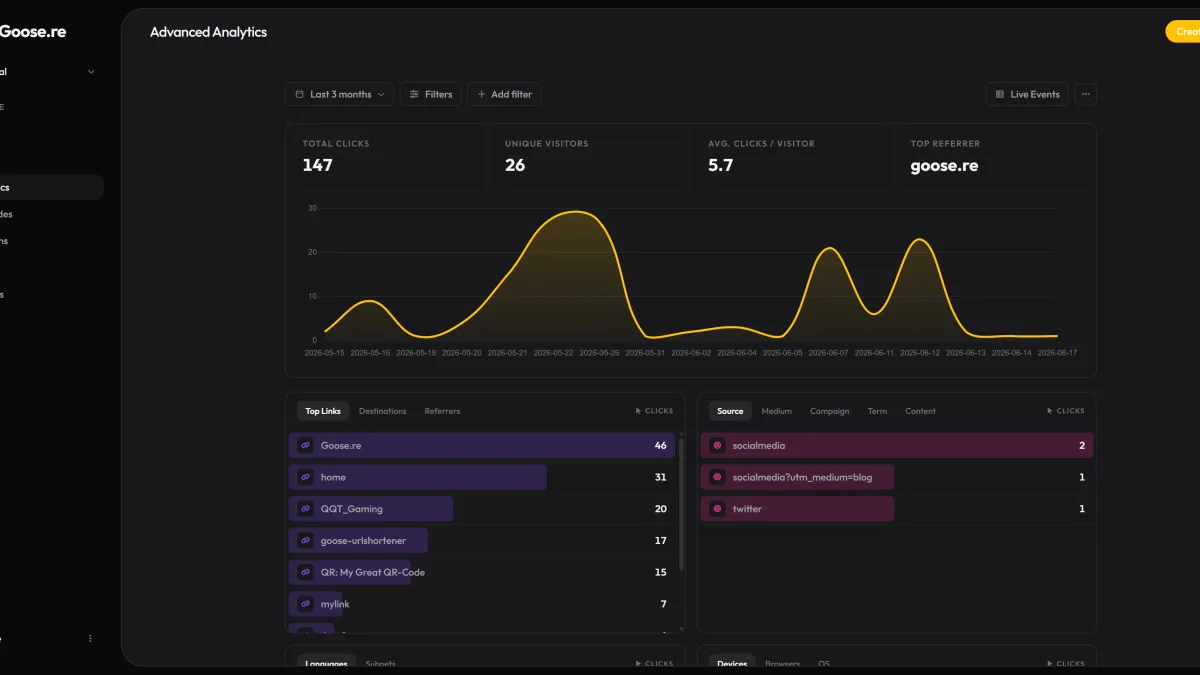
A click count is a starting point, not a complete explanation. Goose.re combines several request signals so teams can compare links and campaigns without claiming more precision than the data provides.
Available measurements
- Time series: hourly grouping for the 24-hour view and daily grouping for longer periods.
- Technology: device class, browser, and operating system derived from the user agent.
- Traffic context: referrer domain, browser language, shortened subnet, and UTM values when present.
- Performance summaries: total clicks, approximate daily unique visitors, top links, and top destinations.
Filtering and export
The analytics dashboard can filter by period, link, folder, tag, and advanced filter rules. CSV export returns the matching raw click rows with timestamps and recorded dimensions. Exported data should be handled with the same care as the dashboard because referrers and subnets can still contain contextual information.
Campaign attribution with UTMs
The link editor can add UTM parameters to the destination URL. Goose.re also records UTM parameters supplied on the incoming short-link request. Use consistent names for source, medium, campaign, term, and content so reports remain comparable.
Split destinations
A link can distribute traffic across configured destination variants and weights. This is useful for directional comparison, but Goose.re records the click rather than a downstream conversion. Evaluate final outcomes in the destination system before choosing a winner.
Act on patterns, not individuals
Use a sustained mobile majority to prioritize mobile testing, a recurring referrer to improve channel-specific copy, or a clear campaign difference to refine distribution. Small samples and missing headers should be treated as uncertainty rather than filled with assumptions.